A way of working where effort feels natural, sustainable, and connected to something you care about.
In Sanskrit, this state is called Sukha — ease, alignment, joy. We call it the Good Space.

Most productivity advice starts with tools and techniques. Good Space starts somewhere more fundamental: the condition of the person doing the work.
Your ability to judge whether something is good — to feel the difference between code that works and code that sings — depends on the state of your nervous system. When you're exhausted, stressed, or running on cortisol, that ability shuts down. You can still ship, but you can't tell if what you shipped is any good.
Good Space is the practice of creating the conditions where your best judgment operates. Not productivity hacking. Something closer to: how do you design your day so the part of your brain that recognizes quality actually works?
This is the entry point for the Rasakrit methodology — a practice for maintaining aesthetic judgment while working with AI at full speed. Good Space is its foundation, because everything else depends on the state you bring to the work. Good Space is the philosophy — the why. Focus & Finish is the implementation — the 21-day program that puts these principles into daily practice.
These aren't productivity hacks. They're the four conditions that, when aligned, let you do your best work consistently.
Knowing what you're building and why it matters. The question that grounds everything: what am I building this for? Without purpose, judgment has no direction. You're moving, but you don't know where you're going.
The mind that isn't cluttered can discern. Meditation, boundaries, digital discipline — saying no to the notifications that fragment your attention into a thousand pieces. Good judgment can't operate in chaos. It requires signal, not noise.
Breath, movement, sleep, nutrition — the body's energy systems tuned for sustained creative output. Not because the body is separate from judgment, but because the body is where judgment lives. A nervous system in survival mode can't discern quality. It can only react.
90-minute cycles. How you enter work. How you exit. The boundaries that protect your judgment by creating recovery windows between deep focus sessions. Rhythm isn't optional — it's the container that makes sustained quality possible.
These aren't rules. They're a sequence that lets your deeper judgment wake up before the reactive mind takes over.
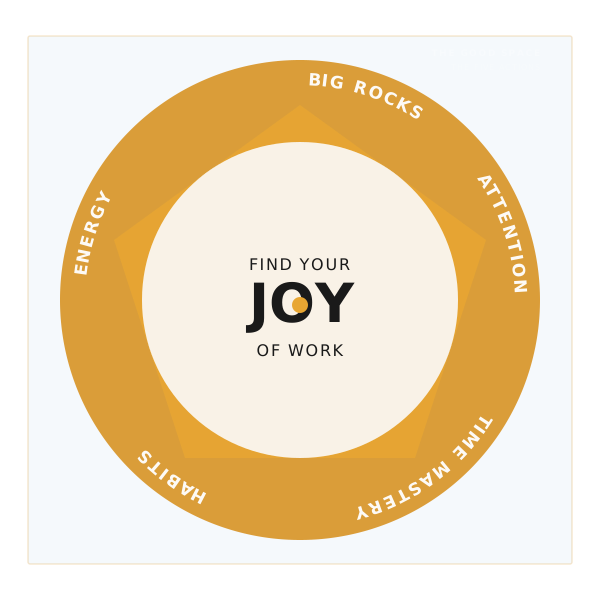
Before the day scatters you, name the one or two things that actually matter. Not the inbox. Not the Slack fires. The work that moves the needle. Put those in first and let everything else fill around them. If you don't choose your big rocks, the gravel chooses for you.
Guard it like the finite resource it is. Every context switch costs you 20 minutes of depth. Every notification pulls you out of the place where good judgment lives. Single-task in 90-minute blocks. One thing, done with full presence. This is how you train the part of your brain that recognizes quality.
Your body runs on a 90-minute attention cycle. Work with it, not against it. Deep work in the cycle, rest between them. Morning for creation, afternoon for coordination, evening for wind-down. Time mastery isn't about cramming more in — it's about knowing when you're sharp and when you're not.
The morning ritual. The evening wind-down. The walk before deep work. The phone left in the other room. Habits are how you stop relying on willpower and start relying on structure. The Moodwah protocols give you a physical anchor — but any consistent ritual will do. Repetition is how the nervous system learns safety.
Sleep, movement, food, sunlight. These aren't lifestyle extras — they're the hardware your judgment runs on. Skip sleep and your sense of quality degrades measurably within 48 hours. Move your body and you signal to the nervous system that creation is possible. Energy management is taste management.
Not everyone arrives here burned out from coding too fast. Some arrive because they've succeeded at things that don't feel like theirs. The work is competent. The career is upward. But the satisfaction that ought to come with success never landed.
This isn't a productivity problem. It's a Dharma problem — a misalignment between what you do and what you're actually for. The yogic tradition calls this the difference between svadharma (your own path) and paradharma (someone else's). Following paradharma with excellence still produces Dukha — the bad space.
Good Space begins before you know what you want to build. The four foundations — Purpose, Clarity, Life Force, Rhythm — are not goals. They are conditions. When they're present, purpose reveals itself. You don't find dharma by thinking harder. You find it by recovering the capacity to taste — and then noticing what you reach for.
The assessment, the practice, the research — all of it works for people who are searching, not just for people who already know. Start with the foundations. Let the rest come.
When you live well, the brain recovers. Stress hormones drop. The neural connections that sustained stress had worn thin begin to rebuild. This isn't metaphor — it's measurable neuroscience.
Research by Liston, McEwen, and Casey showed that after just one month of reduced stress, the prefrontal cortex — the part of your brain responsible for complex judgment — fully regenerates. But it recovers only if you give it the conditions in which recovery is possible.
Rasakrit is built on four pillars: Good Space, Flow Coding, Moodwah, and Daily Tasting Practice. Good Space comes first because everything else depends on it. You can't make good architectural decisions if you haven't slept. You can't think clearly about design if your body is flooded with stress hormones. You can't recognize quality if the body is screaming for rest.
This isn't weakness. This is how the human nervous system actually works.
Good Space is the entry point. Once the foundation is in place, the rest of Rasakrit becomes possible. Your judgment sharpens. And then you can bring that clarity to everything you build.
The papers behind the Good Space methodology.